
- News
- City News
- lucknow News
- ‘VMC needs to work on trash management’
Trending
This story is from December 13, 2016
‘VMC needs to work on trash management’
Recognising trash burning as a major source of air pollution, experts at the air quality workshop here urged the municipal authorities to take steps to curb the practice and strengthen the solid waste management system.
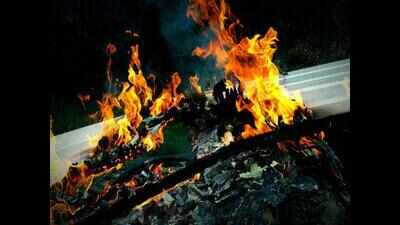
(Representative image)
After his session on dealing with the air quality problem, Prof SN Tripathi of Indian Institute of Technology (IIT), Kanpur, told TOI, “Burning of garbage increases the concentration of suspended particulate matter (PM), resulting in air pollution.

He said bonfires during winters increase the density of fine suspended particulate matter (SPM). Biomass particles get oxygenated and facilitate fog formation. Fog, in turn, lowers visibility levels, with the situation turning worse during winters, especially in Indo-Gangetic Basin.
Varanasi Municipal Corporation (VMC) staff can often be seen burning trash in the open, clearly flouting National Green Tribunal’s (NGT) directive against it. The garbage is also lit on a roadside or next to trees, causing irreparable damage to whatever little green cover the city has.
Municipal Solid Wastes (Management and Handling) Rules (2000), that came into effect in 2001, clearly prohibits burning of garbage and dry leaves. The rules are binding on all municipal bodies. Any violation attracts penal provision of the Environment (Protection) Act (1986) and is punishable under the law. However, the practice is prevalent.
TOI caught up with a fellow of The Energy and Resources Institute (TERI), Sumit Sharma, who said there were many sources of PM emission in UP. About 80% of the cities in the country are violating the set PM guidelines and studies revealed that vehicles and biomass burning are major contributors in PM 2.5 concentrations and needs to be controlled. Modelling studies at TERI have suggested that the whole Indo-Gangetic plain is heavily polluted by particulate matter, he said.
Citing an example of odd-even scheme on pollutant concentrations launched in New Delhi, Sharma said that it could only result in limited reduction in pollutant concentrations. “We believe that dependency on public transports based on electric than fossil fuel based engines would surely improve the scenario. But, at the same time, we need to look at other sources like diesel generator sets, open agricultural residue burning and ban on open burning of refuse needs to be enforced,” he said.
Sharma pointed out that while cars have shifted to advanced BS-IV emission norms in 2010, most heavy vehicles have remained at BS-III.
End of Article
FOLLOW US ON SOCIAL MEDIA









Photostories

Hot Picks
TOP TRENDING
Popular Categories
Hot on the Web
Top Trends
IND vs AUS Live ScoreBaba Siddique NewsVirat KohliRussell WilsonsBaba Siddique DeathBabar AzamWho was Baba SiddiqueBabar AzamNTA SWAYAM July RegistrationLawrence BishnoiAmazon LayoffsToday IND vs AUS MatchManagement Colleges of IndiaTop Medical Colleges of IndiaTop Engineering Colleges of IndiaTop Pharmacy Colleges of IndiaLive Cricket Score
Trending Topics
Diwali WishesDussehra 2024 QuotesDussehra WishesVettaiyan OTT ReleaseVettaiyan CollectionVettaiyan ReviewNatasa StankovicDevara CollectionBigg Boss 18Deepika PadukoneShraddha KapoorRatan Tata Passed AwayJigra Movie ReviewVettaiyan Movie ReviewSwatantrya Veer SavarkarDussehra 2024Star Health Hacker DemandedViral MemesUltimate Football Codes October 2024Wordle Answer
Living and entertainment
Latest News
Accused did recce of Baba Siddiqui's house, monitored him for months: Mumbai PoliceParas Mhambrey joins Mumbai Indians as bowling coachSalman Khan’s security beefed up after Baba Siddiqui’s murder; ‘Sultan’ star looked uncomfortable after visiting the late politician’s family at 3 amBaba Siddique may have died prior to hospitalisation, says doctorsKrushna Abhishek shares a heartwarming post for mama Govinda; says 'jab body mein adha blood supremely talented actor Govinda ka ho...'Zodiac signs likely to have soul connections'Points towards failure of CM': Sanjay Raut slams Maharashtra govt over Baba Siddiqui's killingMahela Jayawardene returns as Mumbai Indians head coachMidnight queues, long waits, bad advice: It's not easy getting therapy in IndiaLoneliness across generations: Why is it important to address this hidden danger?For 500 years, this village in Madhya Pradesh worships Ravan as ‘Kul Devta’Tom Brady is Likely to Become a Minority Owner of Las Vegas Raiders at the Upcoming NFL Fall Owners' Meeting'Rs 64L for errors': Maths teacher fined for totalling mistake of 30 marks in class X exam4.2 magnitude earthquake strikes Assam'Champion of friendship between our two countries': Netanyahu offers condolences on passing of Ratan TataThe Great Indian Kapil Show 2: Kareena Kapoor reveals hubby Saif Ali Khan is jealous of her bond with sister Karisma; says, “He thinks I talk to her more than him”Accused were paid in advance to kill Baba Siddique: Mumbai PoliceMammograms and breast cancer treatment: Separating facts from myths
Copyright © 2024 Bennett, Coleman & Co. Ltd. All rights reserved. For reprint rights: Times Syndication Service